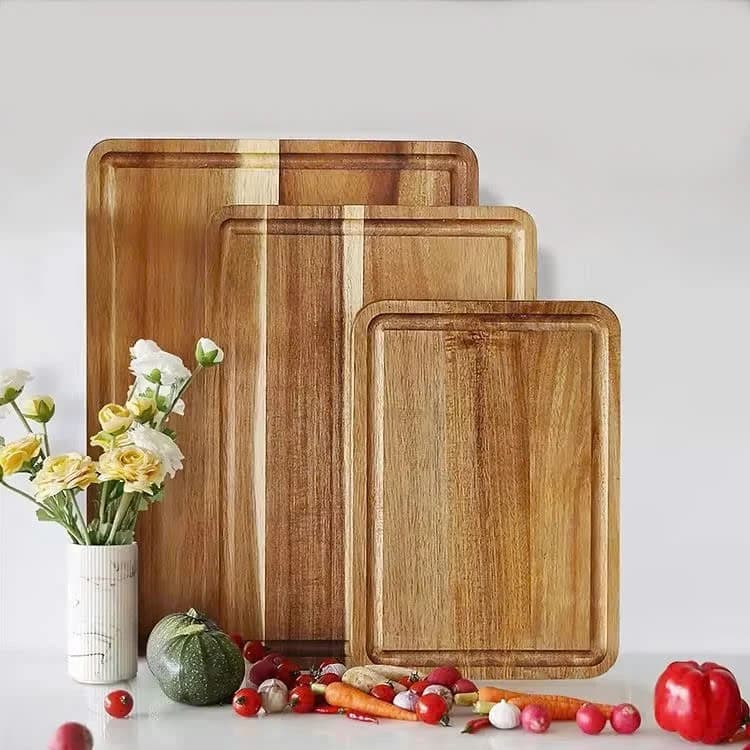
A cutting board and a serving tray have different jobs. Designed together, they can tell one coherent material story.
Bamboo offers a recognisable linear texture that can run through a family of kitchen and tabletop products. The opportunity is to connect that visual character with clear everyday roles: a board for preparation, a paddle for presentation and a tray for carrying and arranging.
01 / BEGIN WITH CONSTRUCTION
Look beyond the surface.
Bamboo belongs to the grass family. For flat products, its material can be processed into strips and laminated panels, a use described in FAO’s World Bamboo Resources. The finished appearance is therefore connected to how the components are prepared and assembled.
A product brief should identify the panel construction, layer direction, colour reference and finish. Ask for a sample that shows the edge as well as the working face. Those views help make the construction understandable before the range grows into multiple shapes and sizes.
02 / THE KITCHEN FAMILY
Start with useful proportions.
Classic rectangles, juice-groove boards and cutout-handle formats provide different ways to organise a cutting-board range. Round boards and serving paddles add variety where the collection also needs to move onto the table.
Choose sizes around the intended use and storage space. A compact board can serve a different purpose from a larger preparation surface; a two- or three-piece set should make that difference clear. Check the usable area after adding a groove, handle opening or other feature. The outer dimensions only tell part of the story.
03 / THE SERVING FAMILY
Give serving its own brief.
A tray needs attention to the rim, base, handle arrangement and the objects it is intended to carry. A long tray may organise small bowls along a dining table, while a handled rectangle offers a different serving format. Divided versions introduce compartments that need their own dimensions.
Review a tray with the intended items in place. Handle clearance, interior dimensions and comfortable handling should be assessed together. Agree the intended load and any relevant verification in the development brief; appearance alone does not establish carrying performance.
“A shared material connects the range. A clear purpose defines each piece.”
04 / MAKE THE FAMILY COHERENT
Share details. Respect the purpose.
Keep a common appearance reference across the family while specifying each product’s construction separately. Document the adhesive and finishing requirements appropriate to the intended use and market, then review the finished samples together.
Care instructions should follow the confirmed construction and finish. Do not infer dishwasher suitability, waterproofing or antibacterial performance from the word “bamboo”. A clear, supported product story is more useful to a brand than a collection of broad material claims.